Days later, my plan went awry. I logged in to be greeted by this message, first on Facebook and then by its equivalent on Instagram.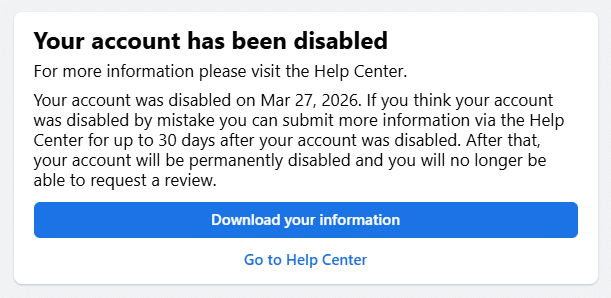
My account had been disabled by Facebook. No more personal or professional accounts.
I tried Instagram and saw that I’d been disabled there, too.
Panic set in. OMG, am I really losing 19 years of content, of documenting nearly 2 decades of my life? Can I no longer access the thousands of conversations I’ve had with people (some of them dear but no longer alive)? Was it all gone, the photos and stories and observations I’d shared, in these places I can’t get back to? What about the life-preservers Friends offered me and my family when Dominic was killed—all gone just like that? UNTHINKABLE.
I saw I had options. Surely this could be fixed. First I’ll hit the Download button to get my content and then I’ll go to the Help Center to straighten everything out.
I soon found out that “Download your information” does not mean “download your content.” The zip files that Facebook and Instagram provided were NOT the content I’d created and wanted to preserve, but instead my ad preferences, a random profile pic from Halloween 2009, a random cover pic from 2016, and a dozen other photos that offer no clue to why they made the cut and thousands of others didn’t.
Oh, and Facebook included its logo in the download. How thoughtful.
Next I went to the Help Center
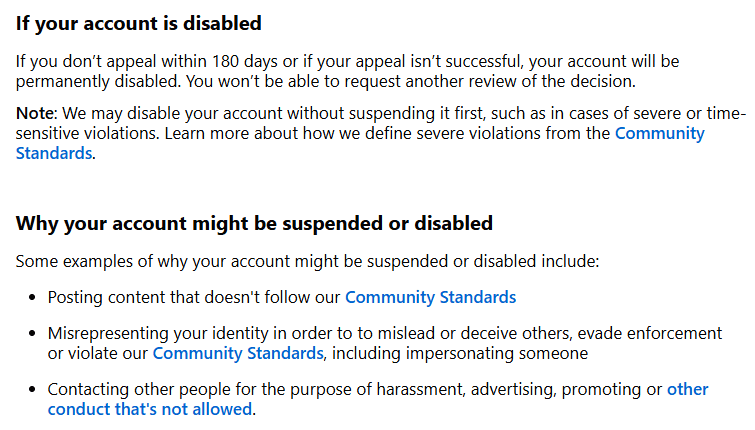
Since I’d gone directly to jail, did not pass Go or collect $200, it was dawning on me that Meta somehow thinks I have done something super-duper egregiously villainous. Surely I can clear this up with an appeal, as suggested.
But know what the first step is in appealing? LOGGING IN. Know what I cannot do? LOG IN.
So I start searching for a way out of my predicament and discover that I am not the only long-time user this has happened to.
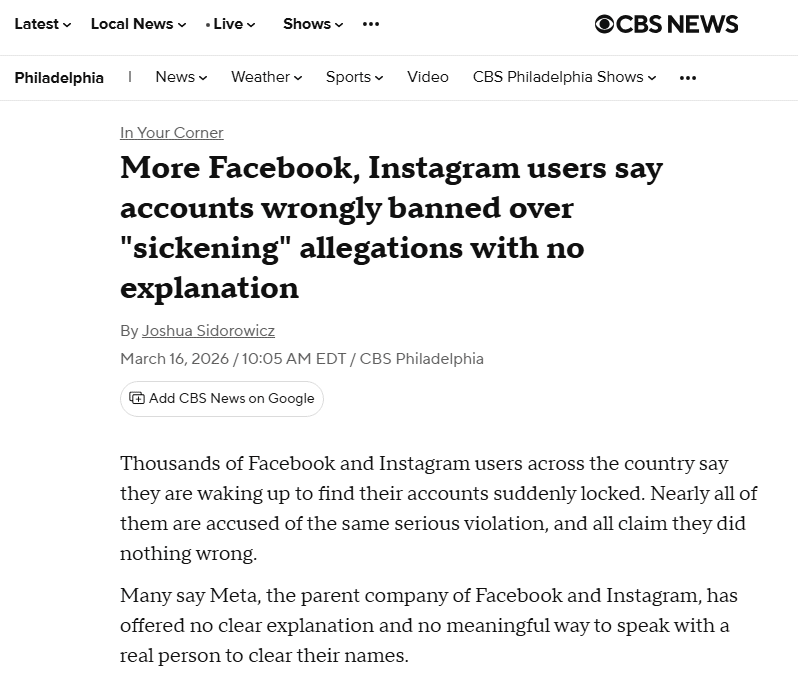
Was this mere AI ineptitude, or something more sinister?
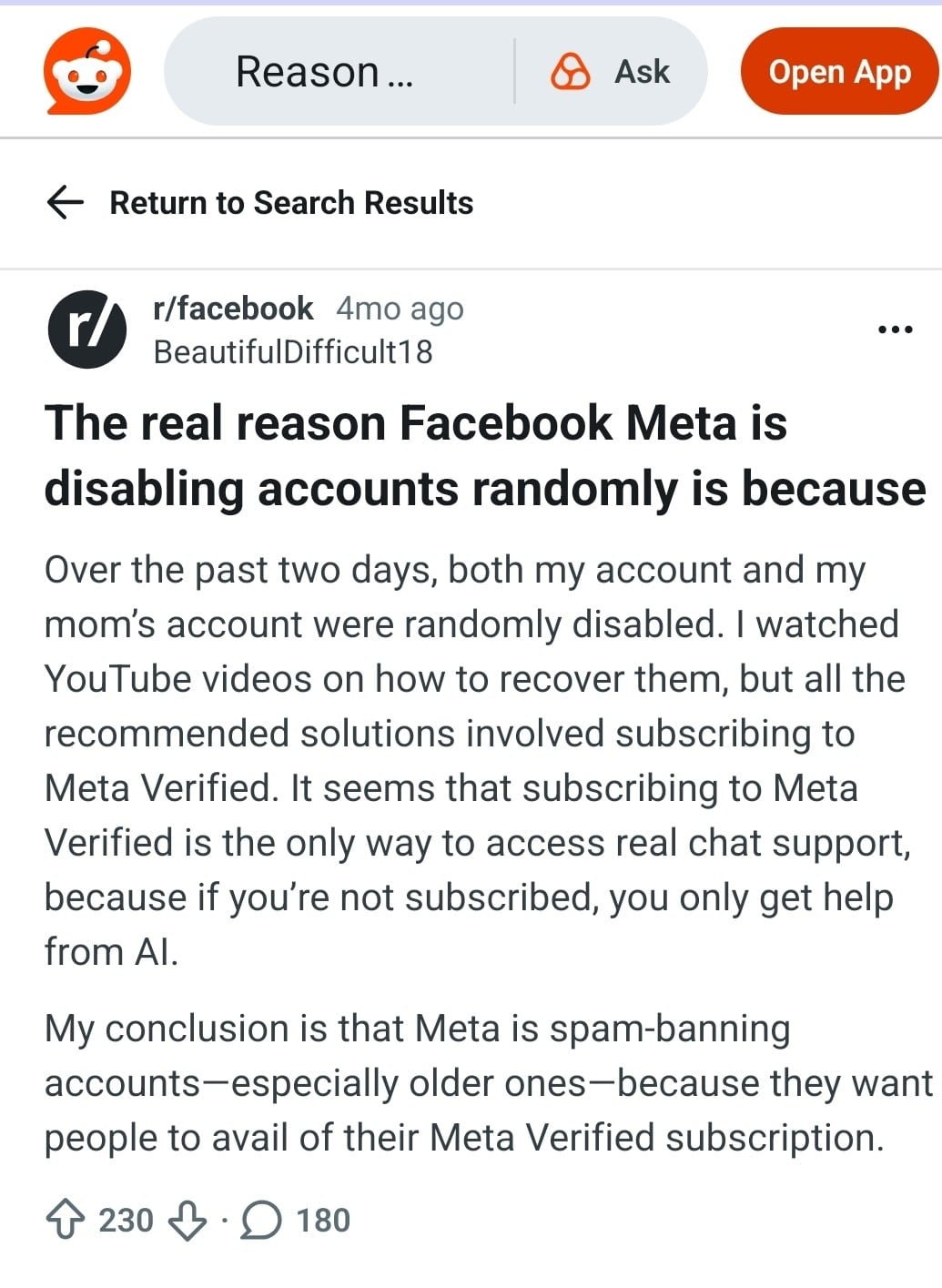
If it’s a mistake, will it be corrected? If it’s a shake-down, should I pay up to regain access?
Either way, it’s clearly enshittification. Through users’ addiction to Facebook, there are ingenious and numerous ways to make our addiction profitable. Think Big Tobacco (there is no evidence that cigarettes cause cancer!), vape companies (candy flavors and cartoon packaging are not “marketing to children!”), and sports betting (your first bet free!).
Yesterday I received this email:
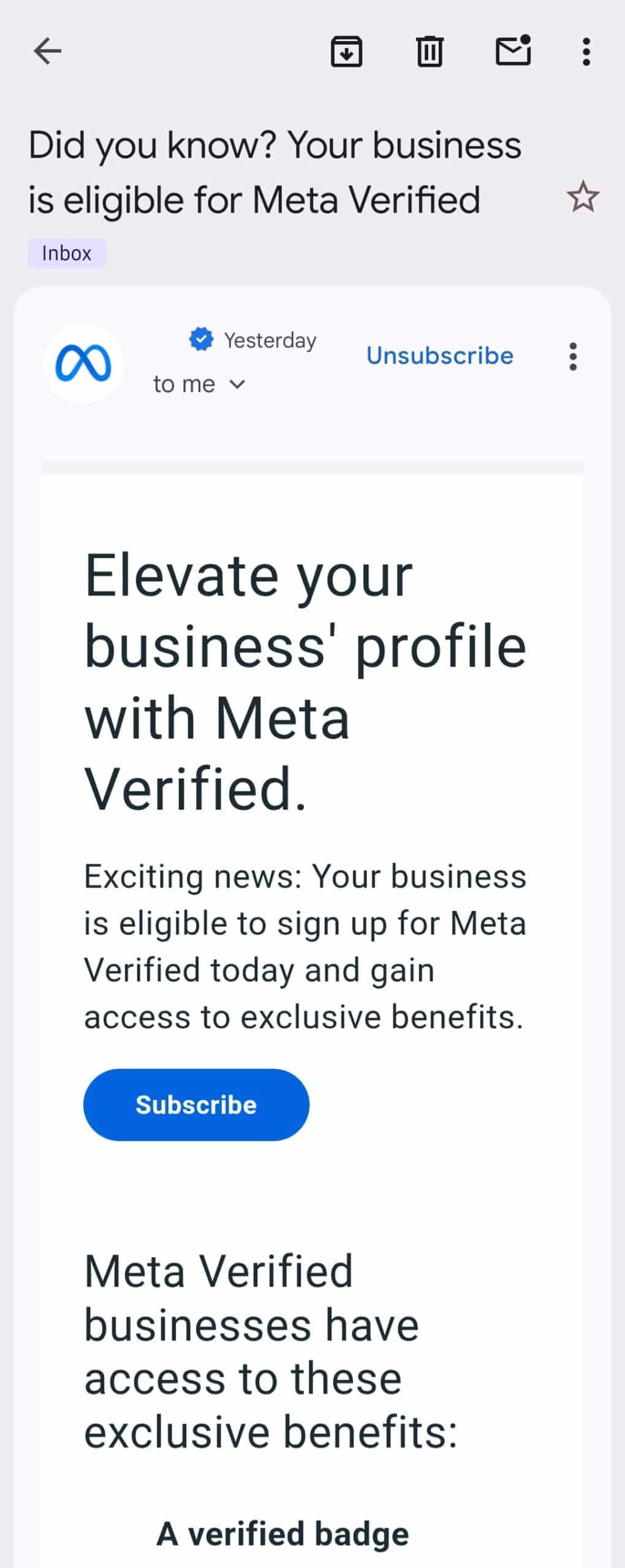
So with one hand Meta delegitimizes me personally and professionally (my account as an author/speaker/coach was also disabled). While the other hand dangles legitimization—as long as I pay a monthly fee.
I’ll pass on the offer, Meta. Just like a Las Vegas casino, the House always wins. Your long game has been to turn me from a person into a user into a commodity.
Pretty poopy of you.
Seems I am also persona non grata elsewhere. LinkedIn won’t let me back on without showing my driver’s license. And when I checked in on Twitter for the first time since a few months after its takeover by a near-trillionaire, I see all my content is gone from there, too.
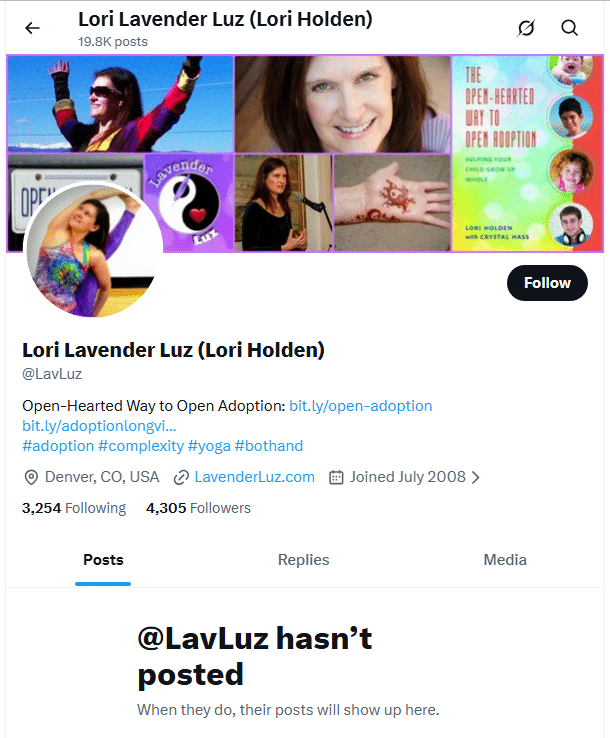
If we were connected on Facebook, Instagram, LinkedIn or Twitter/X (back when it was run by mere millionaires) and if you’d like to keep in touch, please do so by email. If you don’t already have my email address, please use the contact form on this site and I’ll reach back out to you.
Happy life, Friends. I hope to see you again soon, friends.





16 Responses
Lori, I am so sorry to hear this. And angry. Something similar happened to my FB account, different, but infuriating and baffling. It’s such a violation…like someone broke into your home and stole things of value, pictures, memories, etc. And you’re left standing there, thinking WTF, with no recourse.
Holding you while you stew and fret …and get through this stupid challenge.
Thank you for understanding so well, Jo, and I’m sorry that you do! That is a perfect analogy of how it feels.
xo
Whattt! Ian’s been banned from Meta too! I deactivated last August but still use messenger, and I do absolutely feel better without that time suck. Love you!
Then I’m in good company with Mr Fancy! Lovely to hear from you, and please give Ian my best.
xo
This is a powerful article on so many levels. On one hand, I’m sorry you were kicked off of several social media platforms unknowingly and have no way to reconnect if you even wanted to.
One thing you have always told me is to use social media platforms to drive people to your content rather than post your content on the social media platforms — because you don’t own that platform and have little to no control.
On the other hand, Congratulations on your social media sobriety and re-entry back into the real world!
Thank you, Sheri, especially for that other hand. 😊
I know this sort of undermines social media sobriety, but I wonder if Bluesky might be an option?
I’ve been thinking a lot about the topic of enshitification. For example when I call my drs office and am routed through a phone tree through a hold line where I languish for 20 min and longer, only to have the call drop or deliver me to a voice mailbox. I feel our young adults are facing an entire world, where things are so difficult it makes a consumer want to give up.
Maybe FB will enshitify itself out of having users. I’m so sorry for the content you lost
Thank you for the suggestion. I really miss the earlier days of Twitter when it was like a town square. I didn’t go there to talk only with others I already agreed with. I went there to learn from people with difference experienes and viewpoints than I had. We all grew.
But through increasing polarization and demonization, X has become a platform for those who lean one way, and Bluesky, seems to me (without really knowing it or using it) as its counterbalance.
And spot on about enshittification in phone trees. It’s not a bug that people eventually are forced to just give up — it’s a feature. Because who cares when nothing matters to the behemoths?
And I agree that there is a problem with there being ultra-rich who seem to feel no responsibility toward accountability
🎯
You have been right all along by keeping most of your content on your own domain.
In the early days of losing Dominic, I remember desperately wanting to hold on to all of the loving support I got from friends near and far. I don’t know if I thought I would thank them all or turn it into a scrapbook. I have realized that their love is still there, whether or not I can go back through my Messenger archives to find it.
And our memories are still here, whether or not Meta strips us of one way we document our lives.
Shortly after Santa gave Dominic his first phone in 5th grade, I started realizing that there will be a lawsuit against social media/big tech similar to what the tobacco industry faced. They have knowingly designed their products to be manipulative AND addictive. The lawsuits are beginning. Maybe your will be involved in one of them!
A wise woman once told me, if you don’t pay for the product, you ARE the product.
Enjoy your freedom, wise woman.
“their love is still there, whether or not I can go back through my Messenger archives to find it.” Beautiful, Tami. “Social” media and digital memories have clouded what we consider accessible and lasting. This is helpful to me.
I think you will be proven very prescient back when Dominic got his first phone. The addictions of children were always part of the business model.
You’ve really made me think about my social media time and how it truly does take over a person’s life. Thank you friend. I want to stay connected! I never want to lose that❤️I will keep following you and please keep me updated by text. Love you!
Thank you, Kathy! I want to stay connected, too. Thanks for following here, and as far as I know, they can’t take text away from us!
I have been wondering where you were! I find myself spending less time on FB. And I was never on Instagram or Twitter. Ironically, while FB has erased you completely, Meta AI acknowledges your existence (I will email you a screenshot). As I am not a creator, if FB decides to lock me out, I will not be fazed. I’ll miss my Aunt’s family lore posts and pictures of my dog-nephew, but that’s about it. This post is spot on.
Thank you for emailing that screenshot, A. I hope you continue to be able to see your dog-nephew and read family lore, and I agree that life after lockout can be just fine.