
Need help figuring out adoption relationships? Schedule a complimentary consultation with Lori.

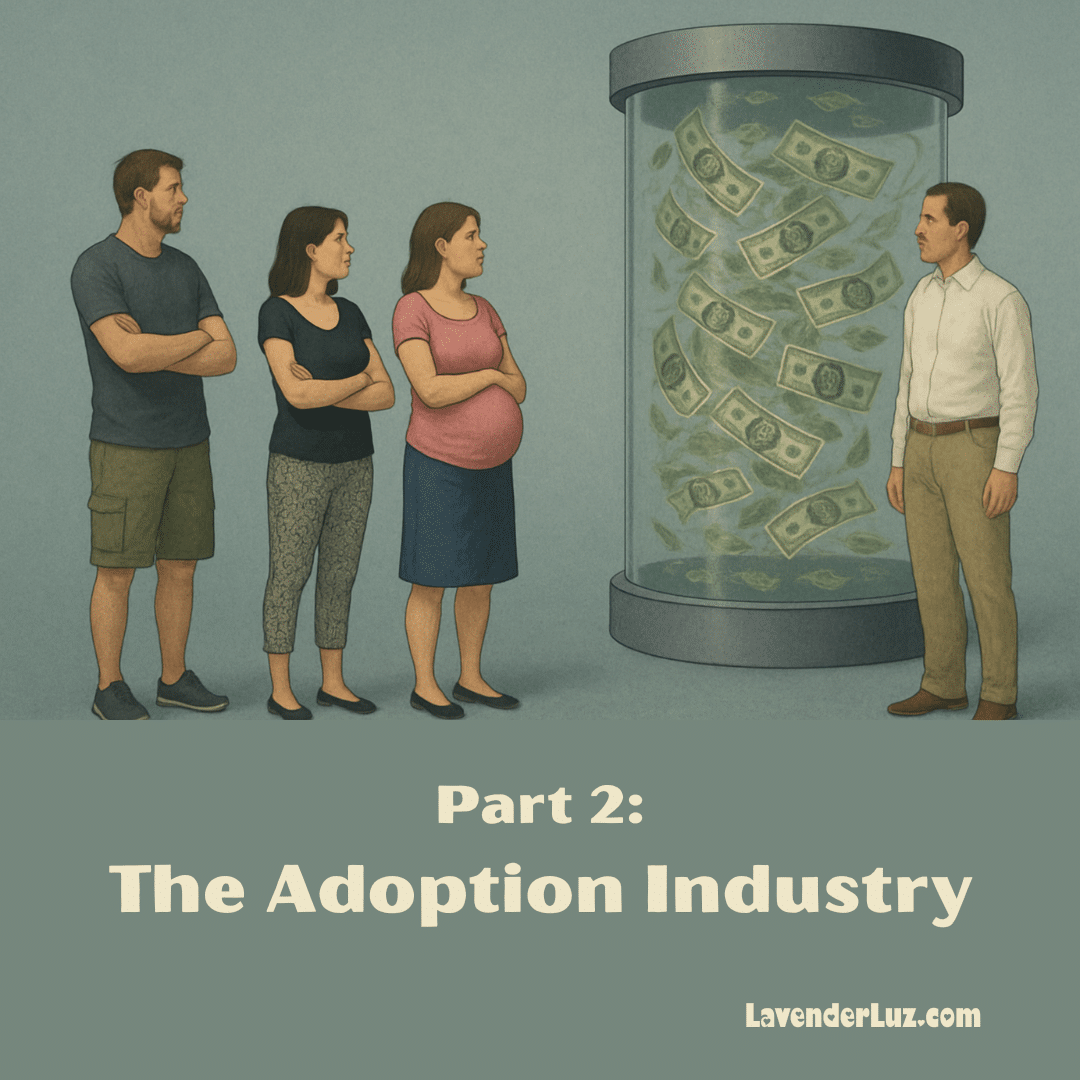
A couple and a pregnant woman are talking with an adoption professional in front of a wind tunnel in which dollars are whirling. Caption says Part 2: The Adoption Industry.

The Adoption Tax Credit & the Adoption Industry

Part 2

The Adoption Industry

In Part 1, we examined how the Adoption Tax Credit (ATC) interacts with supply and demand in two different adoption systems: public (child welfare) and private (infant). The intent behind the Adoption Tax Credit is to reduce financial barriers and make adoption more accessible to more families.

But when you take a closer look, especially within the realm of private (infant) adoption, things get complicated.

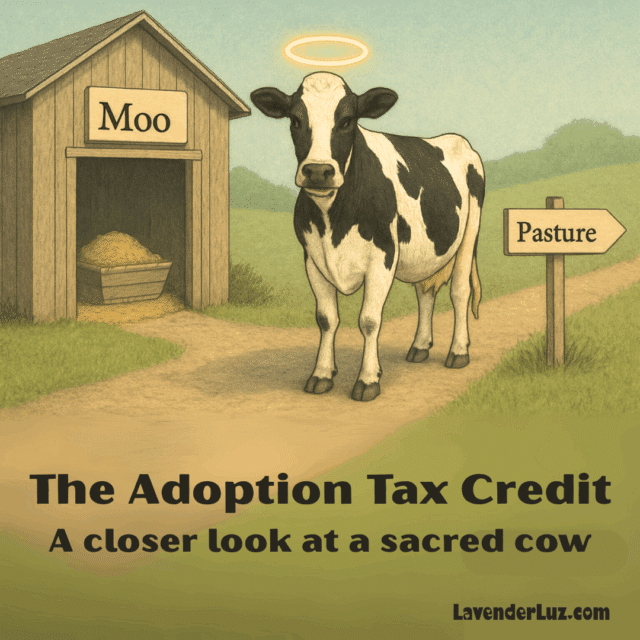
A cow with a halo. To one side is a barn labeled "moo" and to the other a sign saying "pasture."The ATC enjoys broad bipartisan support—from lawmakers across the aisle, from religious coalitions like the Christian Alliance for Orphans, and from advocacy groups such as the National Council for Adoption and RESOLVE: The National Infertility Association. Recently, the ATC became partially refundable through the “One Big Beautiful Bill,” allowing families with no federal tax liability to receive up to $5,000 in cash back.

In the public system, there are not enough families for the number of children waiting. In private adoption, the problem flips: there are far too many hopeful families—at least 50 for every available infant, based on available data.

A policy that helps one system actually hinders the other. The same tax credit that removes financial barriers in foster care adoption ends up increasing costs in private adoption—because there’s no corresponding increase in “supply” (infants available for placement).

(Note as you proceed: It may feel uncomfortable to think about adoption through the lens of economic terms and theories because society tends to think about adoption as something that is altruistic and inherently good. But it is important to consider the economic forces at work behind what is, of course, an industry in which millions (by some accounts, billions) of dollars are exchanged.)


Following the Money

When you inject more money into a supply-constrained domain—such as domestic infant adoption—the money doesn’t create more supply. It simply shifts to those who control access: adoption professionals. And that drives up prices.

The ATC doesn’t make more babies available for adoption—nor should it. But it does increase what adoptive parents are willing and able to pay, which pushes agencies and facilitators to charge more. The adoptive families eventually recover part of the expense via the tax credit.  The extra money has to go somewhere.

An Eggsample

Consider a recent situation: an egg shortage caused by bird flu. If the government decided to give every family a $10 monthly voucher to help buy already-expensive eggs, the likely result wouldn’t be cheaper eggs—it would be even higher prices.

Why? Because the subsidy doesn’t increase the actual supply of eggs. Due to bird flu—and perhaps now, labor shortages—the supply is limited no matter how much extra money is in shoppers’ pockets.

So grocers raise prices, which isn’t always a bad thing. Higher prices help reduce hoarding, which further depletes supply and keeps more customers from having access to eggs (think back to toilet paper in 2020). Higher prices also prompt some buyers to skip the scarce, costly eggs and choose other breakfast or protein options, which helps keep prices from spiraling further upward.

A rising price doesn’t always signal greed (although greedflation is real). But keeping a price artificially low has side-effects, too. When money is injected into a supply-constrained domain, inflation is the predictable outcome.

The same principle applies in adoption. Adoption professionals aren’t necessarily greedy when raising their prices—but in any industry, there will be opportunists ready to take advantage.

Who Benefits?

Ethical adoption professionals might put increased revenues from rising prices toward services that support expectant parents, birth parents, adoptees, and adoptive parents—before, during, and after placement. But others may simply count that increased revenue, thanks to the generosity of American taxpayers, as extra profit.

From the adoptive parent’s perspective, it’s often a wash. Those who finalize an adoption pay inflated prices, but later get some of that money back through the ATC. 

It’s quite the sleight of hand: The ATC makes infant adoption more expensive while giving the impression that it’s more accessible.

What Is and Isn't the Effect of the Adoption Tax Credit on Infant Adoption?

To understand the credit’s actual impact, I reached out to licensed and ethically vetted agency leaders across the country. A program manager at a West Coast agency, explained these salient points:

When families are assessed during the homestudy process, which includes their financial preparedness for adoption and parenting, we have to make this assessment based on their currently available resources. The Adoption Tax Credit is not factored into this assessment, since it would only potentially become available after an adoption. —V, Program Manager

A veteran executive director of an agency in the southwest, shared:

In 35+ years, I’ve never had a couple say they couldn’t adopt without the tax credit. —J, Executive Director

My own informal polling of adoptive parents echoed that sentiment. Not one person said they relied on the credit to pursue adoption. In fact, several didn’t even know about it until after their adoption was finalized.

V* confirms this:

It’s more of a bonus. People usually start asking about it only after placement, not before. —V, Program Manager

J* adds:

I know of no adoptee whose welfare was directly affected by whether or not their parents received the tax credit. —J, Executive Director

When asked about ethics in the system, J offered:
I’ve never seen an ethical agency raise fees because of the Adoption Tax Credit, But I do know birth families whose lives could have been significantly improved if they’d had access to even half that amount of money.
—J, Executive Director

R*, an East Coast agency executive, raised the same issue:

How many mothers and fathers might never have needed to place their child if they had $5,000 in support? —R, Executive Director

W*, a colleague of V, added:

It’s frustrating that the government continues to direct more money to adoption and adoptive families, with no equivalent investment in family preservation. —W, Executive Director

Could the Adoption Tax Credit Enable Baby Brokers?

Ethical-and-licensed agencies  channel extra revenue toward offering more services for clients in the form of pre-adoption counseling and post-placement support. How might less reputable entities respond to the infusion of $17,280 federal funds—per child adopted?

Baby brokers, entities that offer little more than a chance at a match, can charge $20K to $80K per client, often with minimal oversight. Their low overhead (very little counseling and very few services) means they can spend tens of thousands a month on search engine ads, targeting both pregnant women and adoptive parents—each vulnerable and desperate to resolve their respective predicaments. They can also afford to fly pregnant women to “adoption-friendly” states, away from their hometowns and support systems.

In such hands, the ATC doesn’t support ethical adoption. It fuels a high-pressure, profit-driven market.

What if the Adoption Tax Credit Were Eliminated for Domestic Infant Adoption?

If the real-world effects of the ATC, despite good intentions, are higher costs, market inflation, and support for questionable practices, then it’s worth asking: Should the credit be eliminated for private infant adoption?

V ponders that impact.

If private adoption became even less affordable, it might push more people toward public adoption and foster care—which could be good.

That said, some of those people might not be well-suited for foster care. They’re driven by the desire to parent, not necessarily by the flexibility and resilience foster care requires. Adoptive parenting requires an extra measure of flexibility and resilience, and this need is amplified even more when providing care to children in foster care. —V, Program Manager

Further:

It’s somewhat surprising that so many people continue to pursue infant adoption, in light of the decreasing number of placements and the greater recognition of the emotional complexity of the adoption experience.

In some ways, the mere existence of the Adoption Tax Credit serves to promote some of the inaccurate and misguided messaging so prevalent in our country that leads people to want to adopt—that there are so many kids in need of a “good” home—when this is just not the case in private domestic adoption. —V, Program Manager

Advising Clients on the Bigger Picture

R believes it’s essential for professionals to look—and help paying clients (adopting parents) see— beyond dollars to the bigger picture.

We have an obligation to understand the broader effects of the Adoption Tax Credit and to communicate that to our clients. It may be good news for some, but when you zoom out, we are better able to see whether or not this really is the “good news” the National Council for Adoption portrays it to be —R, Executive Director

Coming Up in Part 3: Families for Children

In the final installment of this series, we’ll examine whether the actual effects of the ATC align with the broader goals of adoption: supporting children and families in ethical, sustainable ways.

  • Part 1: Market Forces
  • Part 2: The Adoption Industry
  • Part 3: Families for Children

Based on what you’ve read in Parts 1 & 2, do you think the Adoption Tax Credit should stay or go? Share your thoughts in a comment below.

More Reading

* Interviewees chose not to be identified.

Lori Holden, mom of a young adult daughter and a young adult son, writes from Denver. She was honored as an Angel in Adoption® by the Congressional Coalition on Adoption Institute.

Find Lori’s books on her Amazon Author page, and catch episodes of Adoption: The Long View wherever you get your podcasts.

New Posts Delivered to You

Leave a Reply

Your email address will not be published. Required fields are marked *

New Posts Delivered to You

Be the first to know about each new post. 

(Just a few each month.)