

Part 3
Should the Adoption Tax Credit Stay or Go?
Over the course of this series, we’ve traced the trajectory of the Adoption Tax Credit (ATC) from its well-meaning origins to its complex, and sometimes troubling, consequences.
In Part 1, we explored basic economics—how supply and demand in private infant adoption are grossly imbalanced, with more than 50 hopeful adoptive parents for every available newborn. In such a supply-constrained domain, adding a financial subsidy doesn’t make adoption more accessible—it inflates costs.
In Part 2, we examined how the money flows. The ATC injects cash into the private adoption system. That cash is absorbed by adoption professionals—some ethical and others not—who may raise fees, get aggressive about increasing the supply of infants available, and/or shift advertising strategies to meet heightened demand. These attempts to expand the pool of pregnant women placing their babies reveal ethical dilemmas on the part of adoption providers with the temptation of higher profit.
So in Part 3, we ask the question that should have been guiding public policy from the beginning of modern adoption practices, which started about 100 years ago:
Is adoption supposed to be about sourcing babies for people who want them? Or finding homes for children who need safety and stability?
—Gretchen Sisson, PhD, interviewed in the Liberty Lost podcast and author of Relinquished
I first heard the idea of “homes for children vs children for homes” from the esteemed Dr Joyce Maguire Pavao, an adoptee herself, lecturer in Psychiatry at Harvard Medical School, and foreword writer of the book I co-authored, Adoption Unfiltered™.
(Note as you proceed: It may feel uncomfortable to think about adoption through the lens of economic terms and theories because society tends to think about adoption as something that is altruistic and inherently good. But it is important to consider the economic forces at work behind what is, of course, an industry in which millions (by some accounts, billions) of dollars are exchanged.)
Prioritizing Adults' Desires Over Children's Needs
There’s a marked difference between using public dollars to find homes for children in crisis—and using them to fuel demand for healthy newborns. Yet the Adoption Tax Credit in its current form does not differentiate between the two. It’s a blanket benefit, offered regardless of need or circumstance, favoring those already in a position of relative financial privilege.
J*, the longtime adoption agency executive director whom we met in Part 2, put it this way:
I think the adoption tax credit is, frankly, pork barrel spending that benefits only the taxpayers with the means to adopt, and that if it were really public policy conditioned upon the best interests of children in this country, it would be limited to domestic adoptions of only hard-to-place children and/or bona fide special needs adoptions.
Otherwise, it’s little more than a lucrative rebate offer for those “lucky” (or privileged) enough to adopt the much-desired healthy newborns. After all, mothers of newborns can easily find plenty of placement options available even without the existence of this taxpayer-funded kickback. —J, Executive Director of an agency in the southwest
Fueling Demand, Incentivizing Supply
When a market is driven by high demand and limited supply, and then artificially fueled with government subsidies, something must give. And in adoption, what gives is often ethics.
When you provide government subsidies for the cost of adoptions, when you make adoption more accessible, you are just continuing to fuel that demand, which incentivizes the agencies and the other brokers and players in this space to generate supply…High demand? You have to go out and find more supply. Except the supply in this case is human children.
And that’s where you get into these really coercive practices in the industry. Adoption is not an industry that’s supposed to go out and find babies for people who want to be parents. It’s supposed to be about giving children security. So if those are your reasons to subsidize adoption…that’s fine, but admit that that’s what you’re doing. —Gretchen Sisson, PhD, interviewed in the Liberty Lost podcast and author of Relinquished
This blunt assessment names what must be acknowledged: because infant adoption is demand-driven, the risks to vulnerable families grow exponentially. Especially in private adoption, demand doesn’t just exist—it’s cultivated, incentivized, and monetized.
Verdict on the Adoption Tax Credit
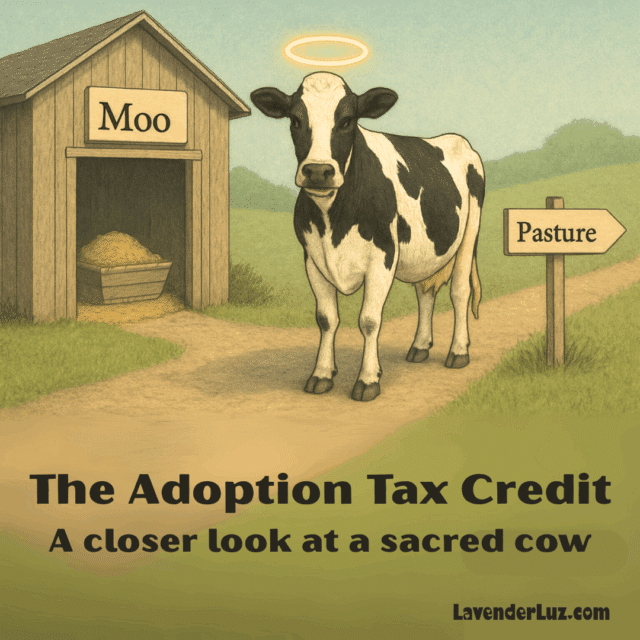
We started this series with a call to periodically re-examine the sacred cow that is the Adoption Tax Credit, which has legions of supporters and very few detractors. Should the ATC be allowed to keep mooing or should it be put out to pasture?
My own conclusion, after chewing on it for weeks, is…
BothAnd
…which comes as no surprise to followers of my work. Keep the ATC in the public system of child welfare, where its impact more closely aligns with its intention. But eliminate the ATC in the private system of infant adoption, where its impacts include raising costs, creating inequities, and incentivizing coercion.
Reorient the Adoption Tax Credit on those it affects most—children truly in need of a home.
A Modest Proposal to Refocus the Adoption Tax Credit
If the goal of adoption policy is truly to serve children—not systems—then we must reconsider how we structure support. The Adoption Tax Credit, in its current form, is a blunt instrument. It lacks targeting, nuance, and ethical guardrails.
It doesn’t distinguish between adopting a teenager from foster care and being able to pay a facilitator $60,000 for a healthy newborn.
Nor does it direct funds toward keeping babies with their families, offering financially struggling expectant parents the same level of support that adopting parents receive.
And it doesn’t ensure that children themselves—the only ones who had no say in the arrangement—receive any meaningful long-term benefit.
A refocused Adoption Tax Credit would prioritize families for children (rather than vice versa) via:
- Adoptions from foster care
- Special needs and children who are considered hard-to-place through no fault of their own
- Post-adoption services for adoptees and birth families
- Family preservation and reunification support when appropriate
.
Let’s stop conflating the needs of children with the desires of adults. Let’s keep the sacred cow for public adoptions, but desanctify it for private adoptions.
More Reading
- National Adoption Week was originally meant for adoption through foster care, but infant adoption quickly piggy-backed onto it.
- Safe Haven Baby Boxes, another case of unintended consequences.
- Homes for Babies or Babies for Homes?
- More on the National Council for Adoption (NCFA)
* Interviewee chose not to be identified.
Do you think the Adoption Tax Credit should continue to apply to private infant adoption? Why or why not?










2 Responses
I loved this entire series — so thought provoking! And Gretchen Sisson and Liberty Lost… All so good.
It can be really hard to look back on the time I hoped for a baby through adoption and all the ethically murky things that initially I thought were worth the end goal. It really underscores how things are backwards. It’s still difficult when people say “if you want a baby you should just get one” without understanding exactly what that means to real life humans.
Thank you for always shining a light on the un-Hallmark underbelly of adoption practices.
Thank you for reading, Jess, and for attesting that the murky things exist.